
Becoming a clothing designer: a 2026 guide
, by Gary KAGO , 10 min reading time
, by Gary KAGO , 10 min reading time
Discover how to become a clothing designer/artist: creative process, AI trends and sustainability, and tips for expressing your original style in 2026.
TL;DR:
- The artist-designer creates a visual identity by drawing inspiration from art, society, and materials.
- The creative process is based on a search for inspiration, sketches, prototypes and continuous experimentation.
- Current trends include sustainability, artificial intelligence, and genderless silhouettes.
Many people imagine a clothing designer hunched over sketches, reproducing fashionable silhouettes. The reality is quite different. A designer-artist shapes a vision, builds a visual identity, and transforms fabric into a personal language. Like Yohji YamamotoThese designers, who have redefined the boundary between clothing and art, do more than just make clothes: they shape a way of being in the world. This guide explores step by step how these artists think and work, and how you, too, can develop an authentic and original creative approach.
| Point | Details |
|---|---|
| Individuality above all | An artist-designer uses clothing as a medium for personal and aesthetic expression, far more than a simple useful object. |
| Structured creative method | The process follows clear steps from the moodboard to the final piece, where each step fosters innovation. |
| Trends to master | Creativity is enriched today through AI, sustainability, and the exploration of inclusive aesthetics. |
| Get started easily | Experiment with sketching, mood boards or upcycling to bring your own clothing vision to life. |
The fashion designer occupies a unique position in the world of fashion. They don't follow trends: they question them, challenge them, sometimes ignore them. Their work stems from a strong aesthetic vision, often informed by art, philosophy, or social observation.
It is useful to distinguish between the different professions that revolve around clothing design. difference between stylist and designer is often misunderstood. The stylist works with trends and creates looks for clients or campaigns. The pattern maker, on the other hand, masters technical pattern making and transforms an idea into a precise pattern. The artist-designer, for their part, places personal expression at the heart of everything.
| Job | Top priority | Relationship to the trend |
|---|---|---|
| Stylist | Composition de looks | Follow the trends |
| Model maker | Technical Patronage | Neutral |
| Artist/Designer | Vision and expression | Creates or challenges |
Her inspirations are wide-ranging: contemporary art, social movements, raw or recycled materials, architecture, photography—anything can become a source of inspiration. Clothing then becomes a medium for personal expression, almost a... artist's notebook carried on one's person.
Among the figures who embody this stance, Yohji Yamamoto remains an essential reference:
“A garment is not a work of art. It is worn daily; it must live with the body.”
This tension between art and function is at the heart of the profession. The artist-designer does not seek to create for museums. He seeks to create for bodies, streets, real lives. Therein lies its complexity and its richness.
Understanding the designer's role is good. Seeing how they actually work is even better. creator's approach It generally follows a structured process, although each artist adapts it to their own sensibility.
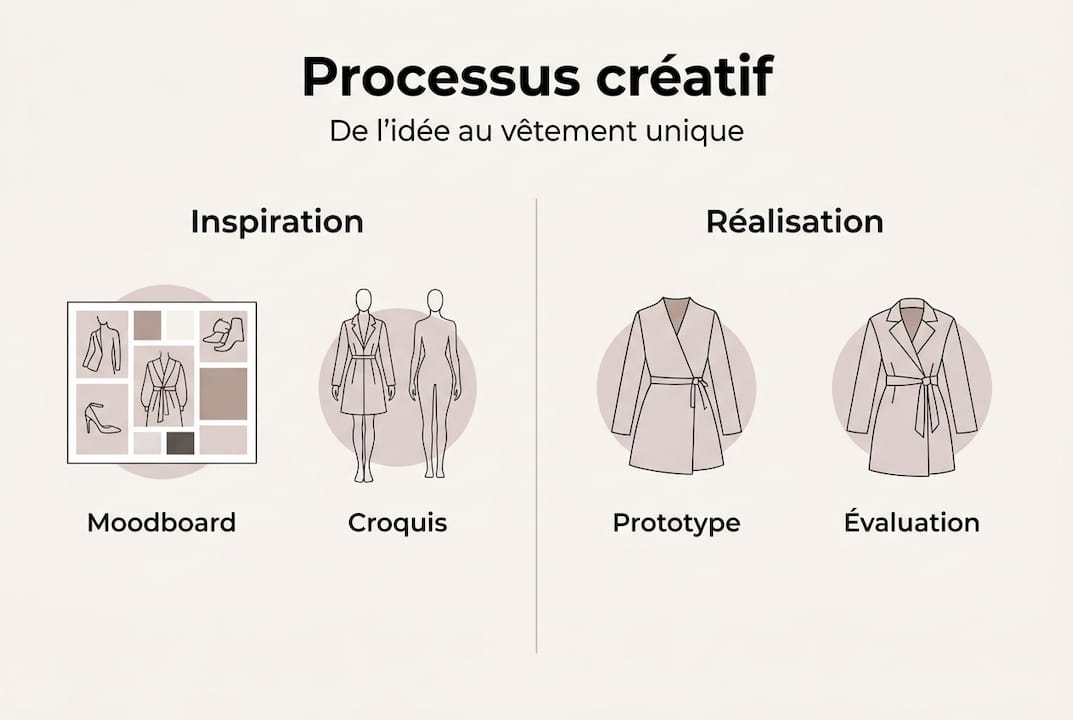
There standard methodology comprises five main phases:
The mood board is often underestimated. Yet, it forms the backbone of any collection. It aligns visual intentions even before the first sketch is drawn. Practicing the daily sketches allows for the development of a personal, recognizable and consistent graphic language.
Experimentation also plays a central role. A failed prototype is not a failure: it's information. The best designers test, unpick, and start again. It is in this back-and-forth between idea and material that the most original pieces are born. creative tools for designers They also evolve with digital technologies, now incorporating 3D modeling software.
Pro tip: Learn the basics of pattern making, even if only in a basic way. Understanding how a garment is technically constructed will give you much more precise control over your creative vision.
Artistic fashion design doesn't happen in isolation. It constantly engages with technological, environmental, and social changes. Three major trends are currently shaping the sector.
The first major trend: artificial intelligence. 72% of designers They now use generative AI in their creative process. Among them, 91% believe it improves the quality of their work, and 89% believe it accelerates their production.
72% Designers are integrating generative AI into their creations, transforming the speed and quality of design.
| Use of AI | Impact observed |
|---|---|
| Moodboard generation | Considerable time-gain |
| Materials simulation | Better anticipation of the rendering |
| Pattern creation | Increased originality |
| 3D Modeling | Fabric-free prototyping |
The second trend is sustainability. Bio-based materials, upcycling, and short supply chains are becoming essential in contemporary collections. committed creation It is no longer a niche positioning. It is a strong expectation of young consumers and professional buyers.
Third trend: genderless aesthetics. trends 2025-2026 confirm the rise of theatricality and gender-neutral silhouettes. These aesthetic choices are also cultural statements. The JOY & FREEDOM Collection Gary Kago's work aptly illustrates this direction, combining color, formal freedom, and personal expression in each piece.
These developments do not replace human sensitivity. They amplify it. The artist-designer who knows how to integrate them has a wider range of expression than ever before. JOY & FREEDOM Collection This is a concrete and inspiring example.
Knowing the trends isn't enough. The real question is: where do you start? Here's a concrete approach to laying the foundations for an original design process.
The first step is to create a personal mood board. Gather images, colors, and textures that appeal to you without asking yourself why. This intuitive process often reveals a coherent aesthetic you weren't aware of. Creating your own artist's sketchbook is a simple yet powerful way to formalize this exploration.
Next, practice sketching regularly. Technical perfection isn't necessary. The goal is to quickly translate an idea into an image. Sketching techniques available online allow you to progress at your own pace, without lengthy training.
Upcycling is also an excellent learning ground. Transforming an existing garment forces you to work with real constraints: shape, fabric, pre-existing seams. It's a hands-on exercise that develops ingenuity.
Genderless and theatrical inspirations allow for the exploration of unexpected stylistic territories. They encourage questioning norms and finding a unique visual signature.
Pro tip: Don't wait until you have all the skills to begin. Test, fail, adjust. Boldness gains power when it is based on regular, even imperfect, practice.
Many young creatives believe that simply being unconventional is enough to succeed in artistic fashion. It's an appealing idea. It's also incomplete.
Experience shows that the strongest expression arises from the tension between creative desire and real constraints. A garment must be wearable. It must take into account anatomy, durability, and sometimes production costs. Ignoring these realities does not liberate the designer; it isolates them.
Yohji Yamamoto himself emphasizes this: clothing is not a work of art in the museum sense. It lives with the body, it wears out, it adapts. This humility in the face of function is a strength, not a limitation.
Creative boldness gains impact when it engages in dialogue with technical rigor. Exploring applied art In portable contexts, this is precisely what distinguishes lasting creators from fleeting trends. True originality doesn't oppose constraints; it integrates and transcends them.
If this world appeals to you, there is a simple way to connect with it: wear pieces designed by artists who have already taken this step.
Gary Kago's JOY & FREEDOM Collection offers clothing that is also a work of graphic art. Each piece carries a vision, a color, an intention. For those who wish to explore further, the gallery of printed works offers a panorama of original creations available for purchase. And to begin simply, the Unisex artistic t-shirt is an accessible entry into this creative universe, without compromising on originality.
The stylist follows trends and composes existing looks, while the artist-designer builds a unique vision and prioritizes innovation over commercial appeal.
Not necessarily. The key is to know how to express your idea, whether through sketching, mood boards, or other visual aids accessible to everyone.
AI boosts creativity and accelerates design: 72% of designers already use it to generate mood boards, simulate materials and create original patterns.
Sustainability, genderless aesthetics and upcycling dominate the 2025-2026 collections, with a strong rise in bio-sourced materials and theatrical silhouettes.
Article generated by BabyLoveGrowth


