
Selecting the perfect art for your clothes: reveal your style
, by Gary KAGO , 11 min reading time
, by Gary KAGO , 11 min reading time
Discover how to select the perfect art for your clothes, assert your creative identity and build an authentic style with method and meaning.
TL;DR:
- Selecting art on clothing is an act of visual and identity expression.
- The creative process involves gathering information, creating mood boards, translating, and editing for consistency.
- Choosing eco-friendly and sustainable designs enhances emotional and environmental value.
In a world saturated with fast fashion and fleeting trends, expressing a truly unique identity becomes a daily challenge. Choosing the art that adorns your clothes isn't a mere aesthetic detail; it's a statement of identity. This guide explores the concrete steps, creative challenges, and pitfalls to avoid to make every garment you wear a true personal manifesto. Whether you're drawn to bold graphic design, poetic illustration, or abstract painting, there's a method to align your artistic choices with what you want to convey to the world.
| Point | Details |
|---|---|
| Express your individuality | Choosing art for your clothes is the best way to express who you are. |
| Structure the creative process | Use mood board and editing to ensure consistency and impact of your selection. |
| Adopt eco-design | Select environmentally friendly materials and workmanship for sustainable clothing. |
| Combine emotion and responsibility | Your style benefits from being both personal and committed, through art and the choice of materials. |
Incorporating a work of art into clothing goes far beyond a simple printed motif. It's an act of visual communication. The garment then becomes a medium, just like a canvas or a gallery wall. Every line, every color, every chosen composition says something about the person wearing it.
Selecting art involves understanding what the artwork expresses before deciding if it represents you. A cold, geometric illustration won't convey the same message as an organic drawing with warm hues. This choice directly impacts your way of...express one's personality in public spaces.
Today's young creatives are precisely seeking this alignment between their inner world and their outward appearance. Street culture has largely contributed to legitimizing this approach. Artists like Jean-Michel Basquiat and Keith Haring have shown that art can live on moving bodies, not just on walls.
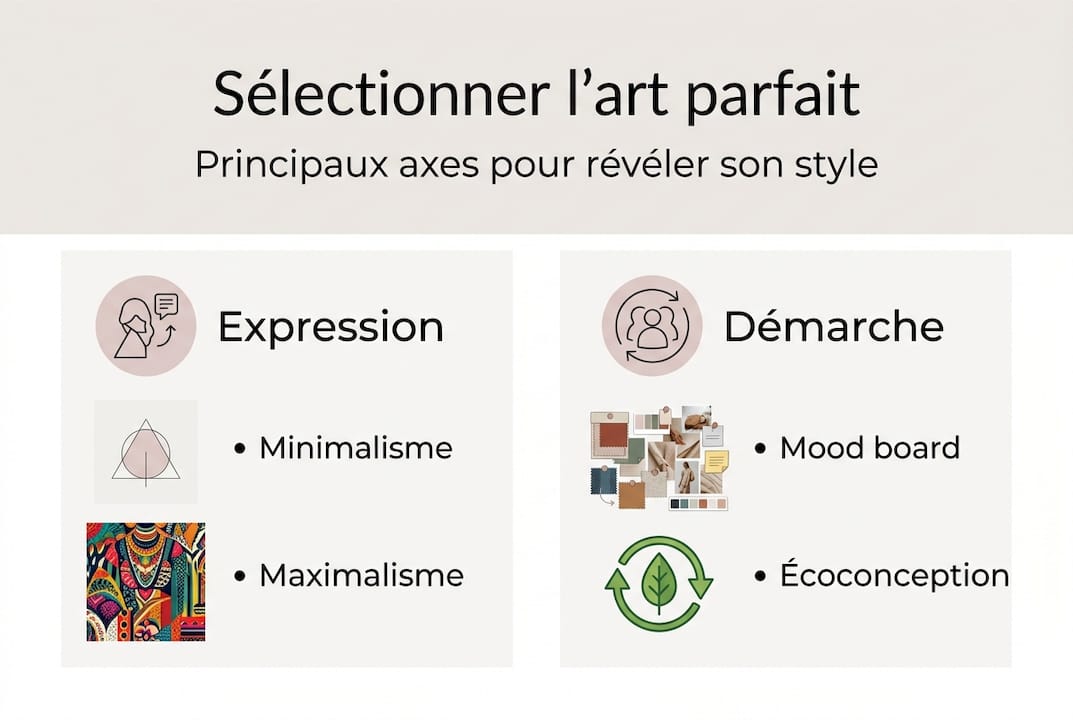
Here are the main current trends in art selection for clothing:
“The opposition between maximalism and minimalism illustrates the different ways to express one's personality through clothing.”
These two poles aren't really opposed. They reflect two different ways of expressing one's style. Minimalism says: I choose the essentials. Maximalism says: I overflow with possibilities. Neither is superior to the other. It all depends on what you want to project.
Street culture has also normalized the mixing of genres. A sweatshirt with an abstract design can be worn in a gallery as well as in a skate park. This fluidity is precisely what makes artistic selection so powerful today.
Moving from a vague desire to a coherent artistic choice requires a method. It's not a matter of innate talent. It's a process that any creative person can learn and refine.
Here are the key steps to building a solid artistic selection:
A mood board is an often underestimated tool. It allows you to see if your inspirations form a coherent visual language or if they cancel each other out. It's also an excellent way to test the compatibility between an artistic style and your existing wardrobe.
Pro tip: Print out a few small images and place them on your current clothes. This physical simulation reveals incompatibilities that the screen doesn't show.
THE iterative process It moves from sources of inspiration to coherent planning, while avoiding the accumulation of superfluous elements. This creative discipline is what distinguishes a strong personal collection from a mere assemblage of motifs.
| Stage | Objective | Recommended tool |
|---|---|---|
| Collection | Nurturing inspiration | Pinterest, notebooks |
| Mood board | Visualize consistency | Canva, collage paper |
| Translation | Fit to clothing | Sketches, mockups |
| Editing | Clean up the message | Critical perspective, feedback |
To take this approach further, explore the path of becoming an artist/designer offers valuable resources. You can also find direct inspiration by browsing original drawings to refine your vision.
Choosing an artistic motif also means choosing how it is produced. This dimension is often ignored, but it is becoming essential for a generation aware of environmental impacts.
Eco-design encourages the choice of single-fiber, non-toxic, repairable, and recyclable materials and designs, while also integrating emotional and physical sustainability. In practical terms, this means that clothing must be designed to last, not just to be appealing for a single season.
Here are the essential ecological criteria to consider:
Key points to remember: A quality artistic garment, worn regularly for five years, has a much lower carbon impact than five cheap pieces bought each year.
| Label | What he guarantees | Level of confidence |
|---|---|---|
| OEKO-TEX Standard 100 | Absence of harmful substances | Pupil |
| GOTS (Global Organic Textile Standard) | Organic fiber + social conditions | Very high |
| Bluesign | Responsible dyeing processes | Pupil |
| Fair Wear Foundation | Fair working conditions | Pupil |
THE eco-responsible artistic approaches They show that it is possible to create beautiful and sustainable pieces without compromising on artistic expression. Eco-responsible art in fashion is no longer a niche. It is a clear direction that many independent designers are taking.
Emotional longevity deserves special attention. A work that truly speaks to you, that resonates with your values or your story, will not go out of style. It will transcend trends because it is rooted in something personal and enduring.
Knowing about environmental trends and issues is good. Knowing how to apply them to your own style is better. This harmonization is often the most delicate step in the process.
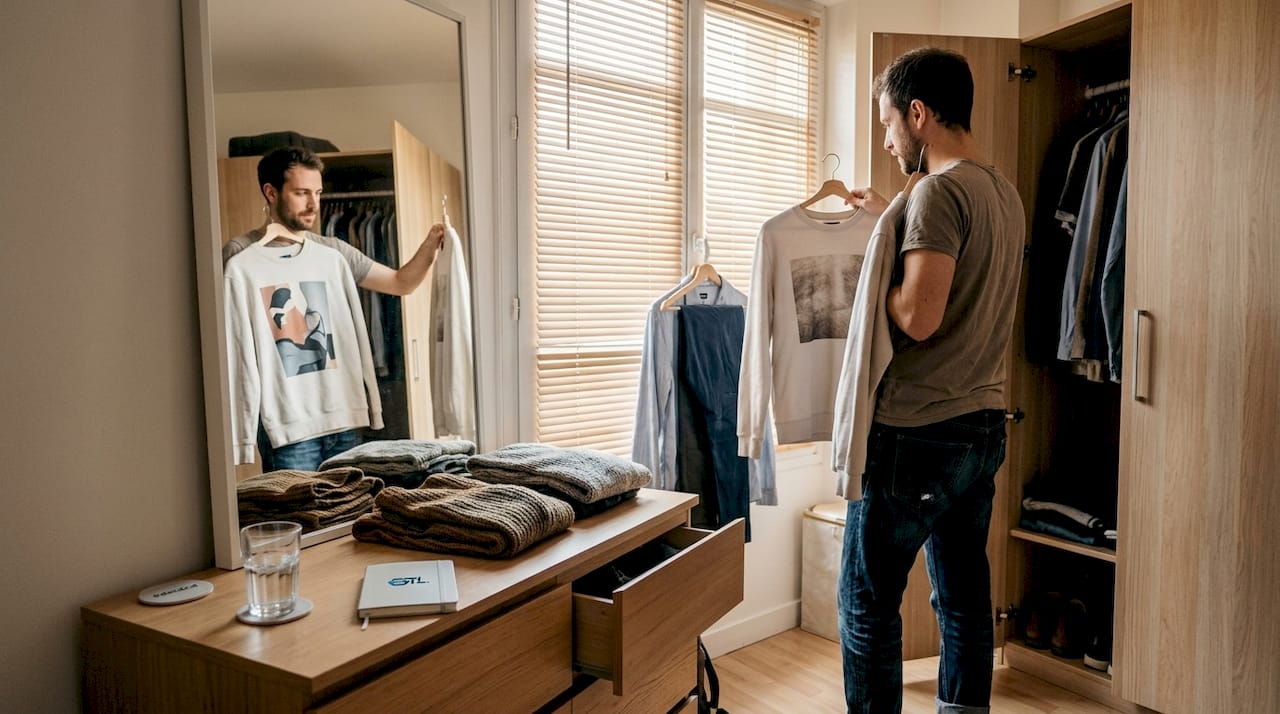
A balance between art, aesthetics, and timelessness allows us to embrace fashion rather than be swept along by it. This means not blindly following trends, but filtering each choice through your own sensibility.
Here are some practical tips for aligning art and personal style:
Pro tip: Before buying the garment, mentally wear it in three different situations. If the piece remains relevant in each one, that's a good sign of coherence.
Simple personalization can have a powerful impact. A subtle yet precise design, placed on the shoulder or back, can transform an ordinary garment into a visual signature. The effect isn't proportional to the complexity of the design; it's proportional to its accuracy.
To refine your approach, the tips for asserting your style offer concrete guidance adapted to creatives who seek to build a coherent and authentic sartorial identity.
Art applied to clothing touches on something that ordinary fashion cannot achieve: lasting emotion. A well-chosen piece doesn't age in the same way as a simple trendy garment. It carries a memory, an intention, a vision.
What seems essential to us is prioritizing the process over the result. A sincere creative journey always produces better choices than a selection guided solely by current trends. Innovation is born from boldness, not imitation.
A garment imbued with art becomes a manifesto. It speaks to your convictions, your imagination, what drives you. This dimension goes far beyond the question of style. It touches upon your deepest identity.
A piece that is imperfect but authentic is better than a perfect piece that is devoid of meaning. It is this authenticity that creates a real connection with those who watch you, and above all, with yourself.
After these discoveries, there's nothing like finding the piece or motif that will reveal your vision. EST.L Shop offers collections designed for creatives who refuse to look like everyone else.

Browse the printed works to find a visual that truly speaks to you. Explore the men's clothing and the women's clothing For pieces that combine graphic art and high-quality wear. Each collection is designed so you can express yourself without compromise. Join a community of art and fashion enthusiasts who choose to wear their world with conviction.
The idea is to choose a visual or artwork that represents your personal world and makes sense when worn on clothing. Artistic clothing allows you to express your identity beyond traditional fashion.
Because environmental and emotional sustainability increases the value and reach of your garment. Integrating the lifecycle and repairability of clothing is essential today.
Assemble visuals, colors, and sources of inspiration on a board to visualize coherence before making a choice. Creating a mood board promotes a cohesive collection and avoids visual overload.
Opt for certified, non-toxic materials and sustainable techniques such as water-based printing and recyclable mono-fibers. OEKO-TEX and GOTS labels guarantee environmental compliance.
The choice depends on your personality and the message you want to convey: minimalism emphasizes subtlety, while maximalism focuses on bold expression. Both trends are used to assert one's individuality through clothing.


