
Artistic styles explained: inspire your art and fashion
, by Gary KAGO , 11 min reading time
, by Gary KAGO , 11 min reading time
Discover the major artistic styles, their techniques, and their influence on fashion. A practical guide to enrich your creative and sartorial expression.
TL; DR:
- Each artistic movement has its own visual, technical and emotional identity.
- Mixing different styles stimulates creativity and creates a unique personal expression.
- Fashion willingly integrates artistic codes to design pieces that are both wearable and meaningful.
Many think that art styles are all the same, that they are simply "old paintings" or interchangeable trends. This is a preconceived idea that slows down creativity. In reality, each artistic movement has its own visual logic, specific techniques and a distinct emotion. These differences don't stay in museums: they run through fashion, textile design, and self-expression. Understanding these styles means giving yourself a powerful visual vocabulary to create, dress and express yourself with more precision and originality.
| Point | Details |
|---|---|
| Differentiating styles | Each artistic movement has its own visual and technical codes to recognize. |
| Techniques signatures | Mastering sfumato, impasto or hatching allows you to experiment with these influences yourself. |
| Fashion and art related | Artistic styles are infused into fashion and allow you to express your personality. |
| Create your syncretism | Mixing and reinterpreting trends gives rise to a truly personal style. |
To distinguish the major trends, let's first look at the evolution of the major styles. Major art movements include Renaissance, Baroque, Impressionism, Cubism, Art Nouveau, Art Deco, and Surrealism. Each responds to a historical context and a very specific vision of the world.
The Renaissance (fifteenth-sixteenth century) valued perspective, natural light and the faithful representation of the human body. The Baroque amplifies the light contrasts and dramatic movement. TheImpressionism captures the fleeting moment with short, vibrant strokes. The Cubism fragments forms to show several points of view simultaneously. TheArt Nouveau is inspired by the organic curves of nature. The Art Deco prefers geometric lines and symmetrical elegance. The Surrealism plunges into the unconscious and dreamlike.
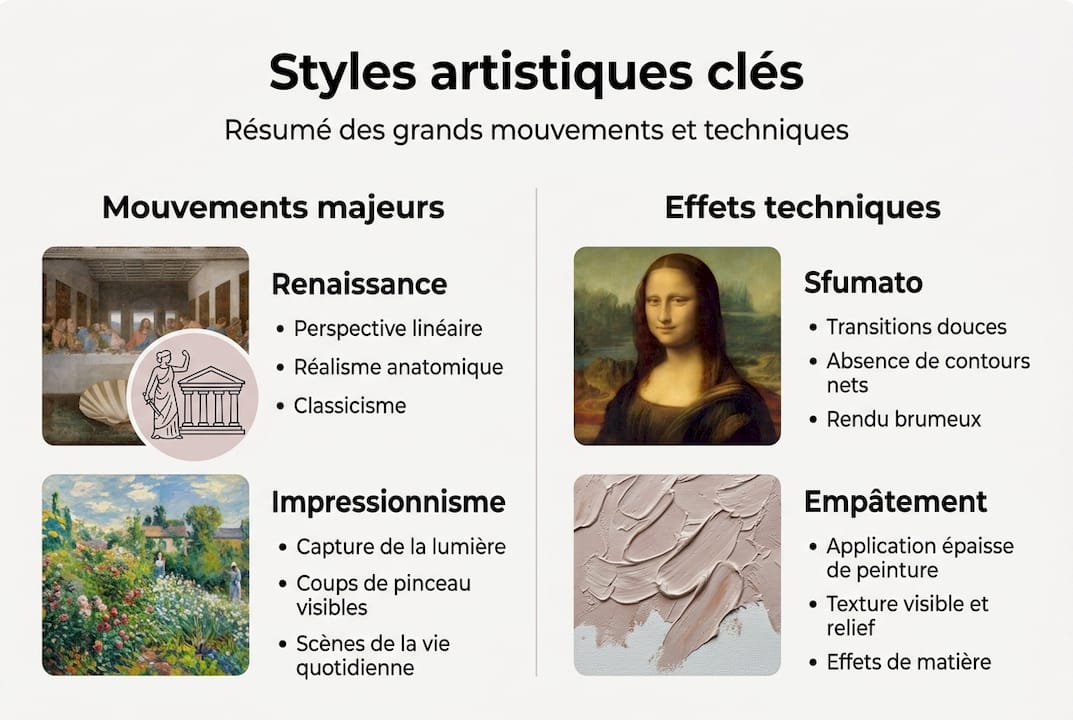
Here is a comparison table to visualize these differences:
| Style | Period | Main Feature | Dominant Colors |
|---|---|---|---|
| Renaissance | 15th-16th centuries. | Perspective and realism | Warm tones, ochres |
| Baroque | XVIIth century. | Light/shadow contrast | Deep blacks, gold |
| Impressionism | Nineteenth century. | Touches courtes, lumière | Pastels, blues, greens |
| Cubism | XXth century. | Shape fragmentation | Grey, Brown, Neutral |
| Art Nouveau | 1890-1910 | Organic Curves | Greens, purples, golds |
| Art Deco | 1920-1940 | Geometry and symmetry | Noir, or, argent |
| Surrealism | 1920-1950 | Imagination and dream | Vivid contrasts |
To recognize a style quickly, here are the signs to look for:
As the analysis of the characteristics ofstyles points out, each movement builds a coherent visual language. A clothing designer who masters these codes can accurately transpose them into their designs.
"Style is the man himself." This formula of Buffon applies to painting as well as to fashion: what you choose to show reveals who you are.
After identifying styles, let's explore the tools and gestures that define them. Each artistic movement is based on precise techniques. Mastering them, even partially, allows you to recognize them in a work and to experience them in your own practice.
Key techniques include sfumato, impasto, hatching, fat on lean, and alla prima. Here is how they relate to each style:
| Technique | Style Associated | Iconic Artist |
|---|---|---|
| Gradient | Renaissance | Leonardo da Vinci |
| Chiaroscuro | Baroque | Caravaggio, Rembrandt |
| Impasto | Impressionism | Renoir, Van Gogh |
| Geometric facets | Cubism | Picasso, Braque |
| Flowing arabesques | Art Nouveau | Mucha, Klimt |
| At the first | Expressionism | Monet, Sargent |
| Bonding and deformation | Surrealism | Dalí, Ernst |
Theimpasto in paint involves applying the paint in thick layers, creating a visible tactile texture. Renoir made subtle use of it, Van Gogh an expressive and almost sculptural one.
To experiment with a technique in your practice, here is a simple approach:
This exploration can be done on a daily basis, even on small formats. Keeping daily sketches is one of the best ways to progress quickly and test out several techniques without pressure.
Pro tip: Don't get stuck in one technique. Mixing sfumato with impressionist touches, or combining hatching and impasto, produces unexpected and personal effects. It is often in these crosses that a truly singular style is born.
By better understanding the techniques, it becomes natural to see how they are invited into fashion. Fashion designers have always looked to artistic movements to feed their collections. This dialogue between art and clothing is alive and constant.
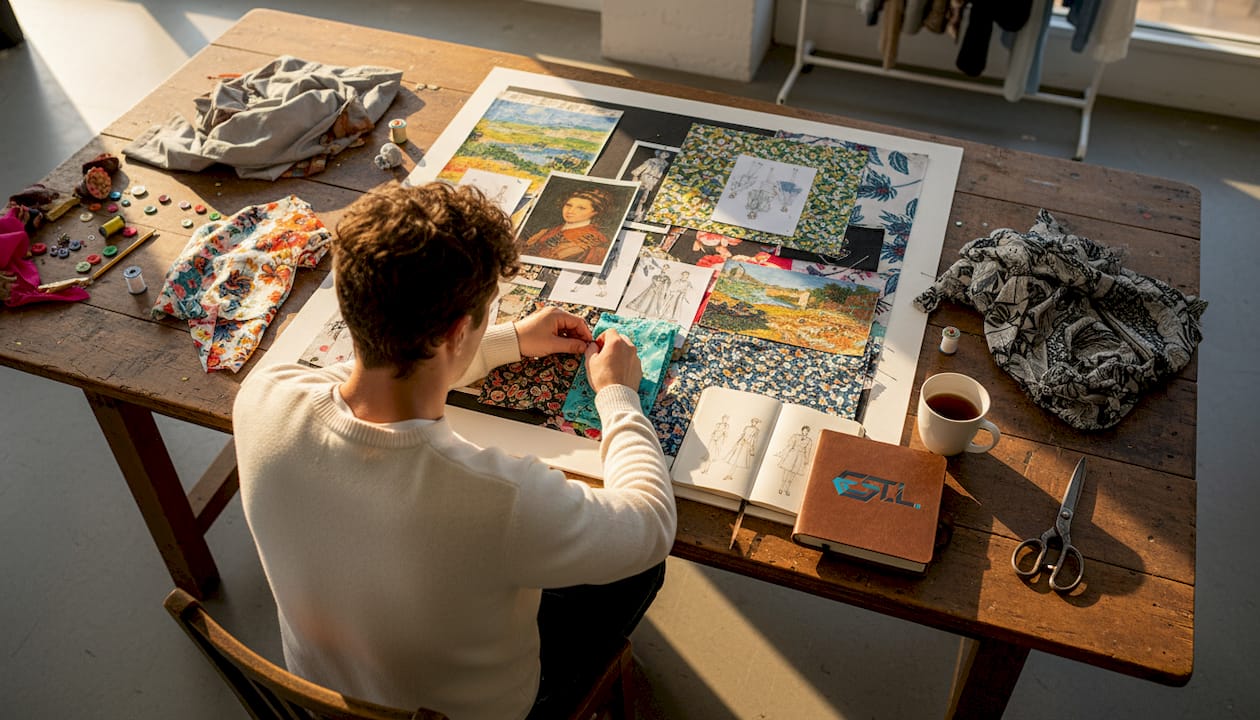
Art Nouveauand Art Deco influenced jewelry and fashion with their distinct visual codes. Art Nouveau brought floral motifs, sinuous lines and shapes inspired by plants and insects. Art Deco, on the other hand, imposed clean cuts, geometric embroidery and symmetrical ornaments.
Here are some examples of direct influences on current fashion:
To adapt an art style to your look or textile creations, start by identifying two or three key visual elements of the chosen movement. Then, look for their fashion equivalent: a color, a collar shape, a print, a material.
Expressing your personality with fashion doesn't require changing everything at once. Sometimes a single accessory inspired by an artistic style is enough to transform an outfit.
Pro tip: Before choosing a style for inspiration, ask yourself what emotion you want to convey. The Baroque evokes power and mystery. Impressionism, lightness and sensitivity. Art Deco, assertive elegance. This coherence between emotion and style makes your personal expression much more readable.
Now, how can we appropriate or merge these currents to express an authentic identity? The first step is to understand two fundamental concepts: realism and stylization.
The realism seeks to represent the world as it is, with precision and fidelity. The stylization simplifies, exaggerates, or reinterprets forms to produce an expressive effect. These two approaches are not opposed: they complement each other and can coexist in the same work or the same outfit.
Other expert shades worth knowing: gesture (or gesture drawing) captures the movement and energy of a figure in a few quick strokes. Perspective organizes the visual space to create an illusion of depth. Divisionism, used by the Pointillists, breaks down color into small, separate strokes that blend optically.
To paint like the Impressionists or explore other trends, you must first accept to experiment without seeking perfection.
Here's how to hybridize multiple styles in your practice:
To detect your natural stylistic affinity, here are a few tips:
Your stylistic explorations gradually form a personal, recognizable and lively visual signature.
It's often believed that an artist or creator has to choose a style and stick to it. This idea is false, and even counterproductive. The most recognizable designers are those who have dared to mix references that no one would have thought to associate.
Picasso fused African art with European tradition to invent Cubism. Yves Saint Laurent drew on Mondrian and Pop Art to create dresses that have become iconic. These hybridizations are not accidents: they are the result of an active curiosity and a desire to go beyond established boundaries.
True style is never set in stone. It evolves with experiences, encounters, readings and essays. Our stylistic reflections show that the designers who progress the fastest are those who accept the discomfort of mixing. Copying an existing style can be useful for learning. But it is in the collision of two unexpected references that something truly personal is born. Shake up the codes. This is where creativity becomes unique.
If you want to go further in exploration or add an artistic touch to your clothing style, our collections are designed for that.

Whether you're drawn to the organic prints of Art Nouveau or the bold lines of Art Deco, the artistic women's fashion and the artistic men's fashion offer pieces that translate these influences into everyday wearables. To go even further, the works in dry pastel allow to integrate art directly into your living space. Each piece is an invitation to extend your exploration of artistic styles beyond the sketchbook.
Renaissance, Baroque, Impressionism, Cubism, Art Nouveau, Art Deco and Surrealism form the basis of a solid artistic and visual culture.
Identify the key techniques of the chosen style, such as sfumato or impasto, and experiment with them in your drawing, painting or textile customization projects.
Fashion draws on the visual codes of artistic styles to enrich patterns, cuts and accessories. Art Nouveau and Art Deco are particularly visible examples of this in contemporary jewelry and collections.
Test different drawing techniques, mix them, and observe what allows you to express yourself most freely and naturally.


