Fashion and personality: understanding its influence on oneself
, by Gary KAGO , 15 min reading time
, by Gary KAGO , 15 min reading time
Discover why fashion influences personality and how your clothing choices can transform your identity and behavior.
TL;DR:
- Clothing actively influences the psychology and identity of individuals, particularly young creatives. Fashion serves as a visual language, boosting confidence and self-expression, while requiring a balance between authenticity and social conformity. A conscious approach allows one to cultivate a genuine style, valuing their individuality and uniqueness.
The clothes you wear each morning don't just describe who you are. They actively help shape who you become. Choosing a bright color, putting on a graphic sweatshirt, or opting for a unique piece is never a trivial act. These choices affect your brain, your behavior, and your relationships with others long before anyone lays eyes on you. This guide explores the precise psychological mechanisms that connect fashion to personality, and how this knowledge can become a concrete tool for creative young adults eager to fully express their identity.
| Point | Details |
|---|---|
| Psychological effect of clothing | Enclothed cognition demonstrates that wearing symbolic clothing affects self-perception. |
| Fashion, identity and self-esteem | Fashion plays a role in building identity and confidence, especially among young creatives. |
| Social pressure vs. authenticity | Finding the balance between individual expression and social expectations is key to staying true to oneself. |
| Role of individual factors | The influence of fashion varies according to personality, age, cultural context and interest in creativity. |
| Towards a truly personal fashion | Experimenting with styles, colors and accessories liberates authentic expression, beyond trends. |
There is a little-known but scientifically recognized concept: clothed cognition. It refers to the psychological effect that clothing can have on the thoughts, emotions, and behaviors of the wearer. This is not a metaphor; it is a real mechanism.
The clothed cognition refers to the systemic influence that worn clothing can exert on the psychological processes of the wearer, according to their perceived symbolic value.
In practical terms, wearing a doctor's coat improves focus and precision. Wearing athletic wear increases motivation to be active. Putting on an artistically patterned garment or a uniquely colorful piece stimulates creativity and openness to experimentation. The effect doesn't just come from how others perceive you; it comes from the meaning you attribute to the garment.
Three mechanisms explain this effect:
These three mechanisms act in combination. This explains why express one's personality The connection through clothing is not superficial. It is a psychologically grounded approach.
Pro tip: The next time you choose an outfit, ask yourself what role or energy this garment activates within you. This simple question can transform an automatic choice into an act of identity construction.
Grasping this first key prompts us to explore the exact role of clothing in our personal construction.
Having understood the overall impact of fashion on psychology, let's look at its specific influence on young adults who are creative and passionate about art.
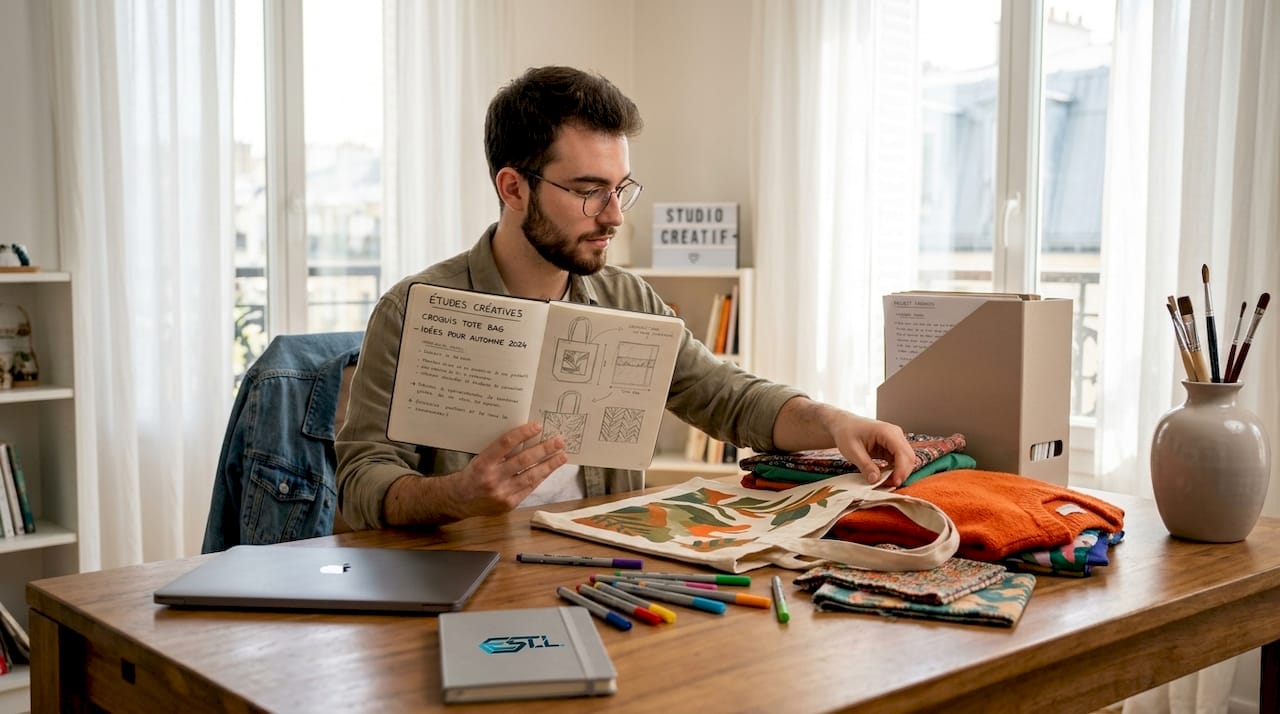
For this generation, fashion is not adornment. It's a language. Each garment worn communicates something specific: an artistic sensibility, a cultural affiliation, a worldview. Style becomes a non-verbal vocabulary, often more eloquent than words.
THE clothing choices They directly contribute to the development of identity and self-image, establishing a link between stylistic singularity and self-esteem. It's not just about appearances. It's about becoming.
Here's how fashion supports the identity affirmation of young creatives:
| Identity aspect | Impact observed | Concrete example |
|---|---|---|
| Self esteem | Reinforced by the feeling of coherence | Wear colors that you really like |
| Social trust | Augmented by the embraced singularity | A graphic piece that generates interest |
| Perceived Creativity | Amplified by visually strong choices | Combination of unusual patterns |
| Cultural affiliation | Affirmed by artistic references | Clothing inspired by an artistic movement |
The link between fashion and art is particularly strong here. A piece that features graphic artwork or a carefully constructed color palette isn't just a fashion item. It's a wearable artistic statement. To better assert your styleFirst, you have to accept that his style exists and deserves to be seen.
This social dimension raises the question of the motivations behind each choice: for oneself, or for others? We offer here a comparative perspective.
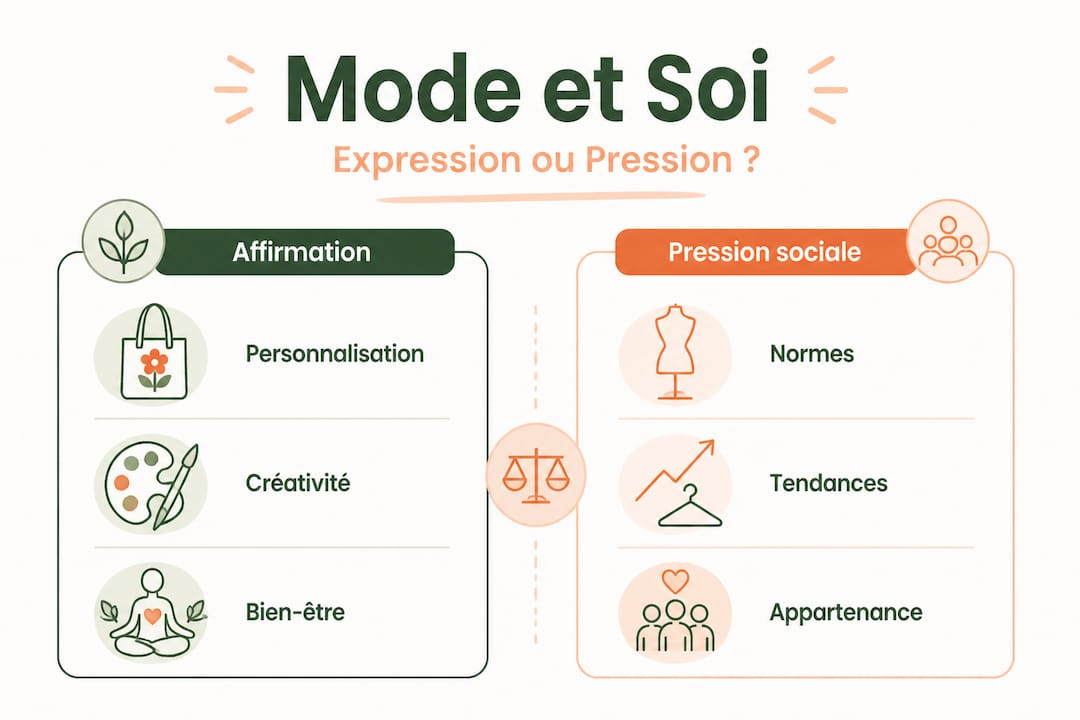
Fashion evolves in a space of tension. On the one hand, it offers a powerful tool for individual expression. On the other, it is permeated by collective norms, trends, and expectations that can encourage conformity rather than distinction.
There mode serves as a resource to negotiate identity between personal aspirations and social expectations, creating a constant ambivalence between the desire to stand out and the need to belong.
| Authentic expression | Social conformity |
|---|---|
| Clothing chosen for its personal meaning | Clothing chosen for its social approval |
| Stable confidence over time | Dependence on changing trends |
| Uniqueness and memorability | Integration and discretion |
| Creativity stimulated | Limited creativity |
| Intrinsic self-esteem | Conditional self-esteem |
The risks of conformity are real:
But social pressure isn't all negative. It can also offer opportunities. Negotiating one's place in a group through one's style, finding a community that shares one's artistic tastes, or drawing inspiration from a collective movement to reinterpret it in one's own way are all forms of creative empowerment. accessible mode It does not mean a trivial fashion. It can be the starting point for a deeply personal expression.
Pro tip: Before buying an item, ask yourself this simple question: “Am I wearing this because I like it, or because I’m afraid of not being seen as normal?” The honest answer will tell you a lot about your real motivations.
Explore different creative styles to identify those that resonate with your deepest identity rather than with the expectations of those around you.
Beyond the interplay between conformity and individuality, the question arises: why doesn't fashion shape everyone in the same way?
The answer lies in individual variability. clothing preferences They vary according to demographic factors, personality traits, and the degree of interest in fashion. What works for one individual may not change anything for another.
Several variables modulate this effect:
Approximately 62% of individuals surveyed in studies on clothing behavior report that their clothing choices directly influence their mood and energy levels throughout the day.
Personal style emerges at the intersection of all these factors. There is no universal formula. This is precisely what makes it authentic when it is well-crafted. The encounter between art and fashion takes on its full meaning here: it offers a territory of expression adapted to each sensitivity.
To delve deeper into understanding these mechanisms, this creative fashion guide can accompany a more personal reflection on your own stylistic preferences and motivations.
With these factors in mind, let's move on to some concrete tips to best express who you are through fashion.
The combination of mechanisms such as identity priming, bodily experience, and social feedback explains why some people seem to literally radiate in their clothes. This is not by chance. It is the result of a coherence between what they wear and who they are, or aspire to be.
Here is a gradual approach to transforming fashion into a tool for self-fulfillment:
There clothing customization is one of the most effective levers. Adapting a piece, adding a graphic element, or combining it in an unexpected way transforms a standard item into a unique object of expression. artistic accessories They also play an important role: they allow you to add a creative dimension without changing the entire outfit.
Pro tip: Photograph your favorite outfits over a period of a few weeks. You'll quickly see recurring patterns in your choices: dominant colors, types of garments, overall moods. These constants are your natural style. Start from there.
It's tempting to believe that following trends is the surest path to a strong style. But this idea deserves serious consideration.
Trends are by definition ephemeral. They emerge, explode, and disappear. To conform to them entirely is to build one's identity on shifting ground. A person who defines themselves by a trend will have to redefine themselves every season.
It's important to note that clothing influences perceptions and behaviors, but personality isn't defined solely by clothes. Individual motivations and interpersonal differences remain crucial. In other words, clothes amplify and support an identity; they don't create it from scratch.
This realization changes everything. It means that true strength lies not in the clothing itself, but in the coherence between what you wear and who you truly are. A person who wears simple pieces with complete conviction often exudes more personality than someone dressed in the latest trends without any real connection to them.
Authenticity is appealing. It generates memorability, respect, and a form of admiration that transcends seasons and magazines. Using fashion as a channel for sincere expression, exploring forms of everyday creativity Rather than seeking external validation, this is what builds a lasting identity.
Fashion is a remarkable tool. But like any tool, its effect depends on the hand that holds it and the intention that guides it.
Understanding the psychological mechanisms of fashion is one thing. Finding pieces that actually activate them is another.

EAST.L Shop offers a selection of clothing designed specifically for creatives who want to express their identity with sincerity. Inspired by the creations of Gary Kago, the collections combine graphic art, color, and originality in pieces that can be worn every day. Each item is an invitation to assert your individuality without compromise. Whether you're looking for a statement piece to define your style or an outfit that reflects your artistic sensibility, you'll find what you're looking for in the original men's collection and the bold women's collection Options that truly reflect who you are.
Clothing with strong symbolic meaning for the individual, particularly clothing associated with valued roles such as artist or creative, produces the most pronounced impact. The effect depends on the meaning attributed to the garment and the experience of wearing it.
Yes, this process begins early, particularly through the negotiation between individual autonomy and the need to belong to groups. Fashion serves as a resource for navigating the ambivalence between personal aspirations and social expectations from adolescence onward.
The two factors work together: personality guides basic preferences, but the cultural and social context strongly influences stylistic expression. Preferences and underlying factors vary inextricably according to personality and environment.
Yes, and it's often more effective. Intentionally choosing colors, textures, and accessories that align with one's deep sensibilities builds a more lasting and memorable style than adhering to seasonal trends.


