
How fashion shapes your identity and reveals your creativity
, by Gary KAGO , 14 min reading time
, by Gary KAGO , 14 min reading time
Discover how your style reveals your identity through fashion. Express yourself and explore your creativity every day with your clothing choices.
TL;DR:
- Every morning, our clothing choices shape our self-image, reflecting our identity, values, and mood. Fashion also impacts psychology, influencing confidence and performance through "enclothed cognition." Original pieces allow creative individuals to assert their individuality in the face of fast fashion and societal norms.
Every morning, when you open your closet, you're doing much more than choosing an outfit. You're constructing a version of yourself. This seemingly mundane gesture is actually a silent statement about who you are, how you feel, and how you want to be perceived. Social psychology researchers have been confirming this for decades: our clothes don't just cover us, they define us. For young creatives, this reality takes on an even stronger dimension, as fashion becomes a language in its own right, rich in nuances and intentions.
| Point | Details |
|---|---|
| Visible social identity | Clothing signals belonging to a group and reinforces self-esteem. |
| Real psychological impact | Choosing one's clothes influences confidence, creativity, and performance. |
| Fast fashion challenge | To preserve its originality, one must avoid the conformity imposed by mass fashion. |
| Unique and valuable pieces | Original creations are powerful tools for self-affirmation. |
| Authenticity or belonging | Fashion oscillates between authentic expression and the search for social acceptance. |
Fashion is never simply about aesthetics. It speaks to who we are and which group we belong to. This is precisely what psychologist Henri Tajfel highlighted in his theory of social identity. According to him, individuals construct their identity, in part, through the groups to which they belong. Clothing plays a central role in this process.
Fashion serves as a marker of social identity. According to Tajfel and Turner's theory (1979), clothing choices signal group membership and reinforce self-esteem through the ingroup. The ingroup simply refers to the group with which one identifies, the one whose codes and values one shares.
For young adults, this effect is particularly noticeable. Clothing choices reflect and shape Identity, self-esteem, and social belonging. Young people with high self-esteem experiment with unique styles to assert their individuality, while others remain conformist to avoid peer scrutiny.
Here's what fashion communicates, often without you being aware of it:
“Clothing is a sign before it is a thing. It speaks before you open your mouth.”
This tension between belonging and distinction is at the heart of theoriginality of dress What young creatives are looking for. Asserting one's style means navigating between two opposing forces and finding one's own balance.
Enclothed cognition is a concept developed by researchers Adam and Galinsky in 2012. It refers to the psychological effect that our clothes have on our thoughts and behaviors. In other words, what you wear actually changes how you behave and perceive yourself.
Clothed cognition shows that clothing influences psychological processes. Wearing formal clothes boosts confidence and performance, as shown in the study by Adam and Galinsky (2012). In this experiment, participants wearing a doctor's coat performed significantly better in terms of attention and concentration compared to those wearing ordinary clothes.
| Clothing situation | Observed psychological effect |
|---|---|
| Formal or structured clothing | Increased confidence and abstract thinking |
| doctor's coat worn | Improved focus and precision in tasks |
| Creative or expressive clothing | Stimulating creativity and risk-taking |
| Sportswear | Mental activation and a sense of competence |
This chart illustrates a concrete reality: your wardrobe is also a tool for personal performance. This isn't superstition. It's science applied to your daily life.
There creative fashion and confidence are deeply connected. Wearing a piece that authentically represents you generates a feeling of inner alignment. You feel more consistent with yourself, and this is reflected in your posture, your gaze, the way you occupy space.
Pro tip: If you're going through a creative period, try wearing bright colors or artistic prints in the morning. The effect of enclothed cognition can activate a more open and inventive mindset right from the start of the day.
There unique style and personality They are therefore inseparable. What you choose to wear in the morning is never neutral. It is a conscious or unconscious act of self-presentation, with very real effects on your confidence and abilities.
Expressing one's individuality through fashion is not as simple as it seems. Young creatives often find themselves caught between two contradictory forces: the desire to stand out and the pressure to look like everyone else.
Fast fashion amplifies this paradox. It produces trends at a frenetic pace, making each "unique" style accessible to millions of people simultaneously. As a result, the item you thought was original can be seen on hundreds of passersby the following week.
A quantitative study on students The study reveals that 80% of respondents say that dressing well improves their self-esteem. However, the same study shows that their choices remain heavily influenced by fast fashion trends and peer pressure. This figure reveals a deep tension: people want to feel good in their clothes, but they remain very dependent on social perceptions.
Here is the difference between two approaches to clothing:
| Criteria | Mass fashion (fast fashion) | Creative and personal fashion |
|---|---|---|
| Source d’inspiration | Global trends, algorithms | Personal values, art, culture |
| Part lifespan | A few weeks or months | For a long time, perhaps always |
| Impact on identity | Conformity and mass belonging | Affirmation of uniqueness |
| Environmental impact | High-quality, fast-producing | Reduced size, carefully selected pieces |
| Relationship with oneself | External, peer-reviewed | Internal, aligned with its values |
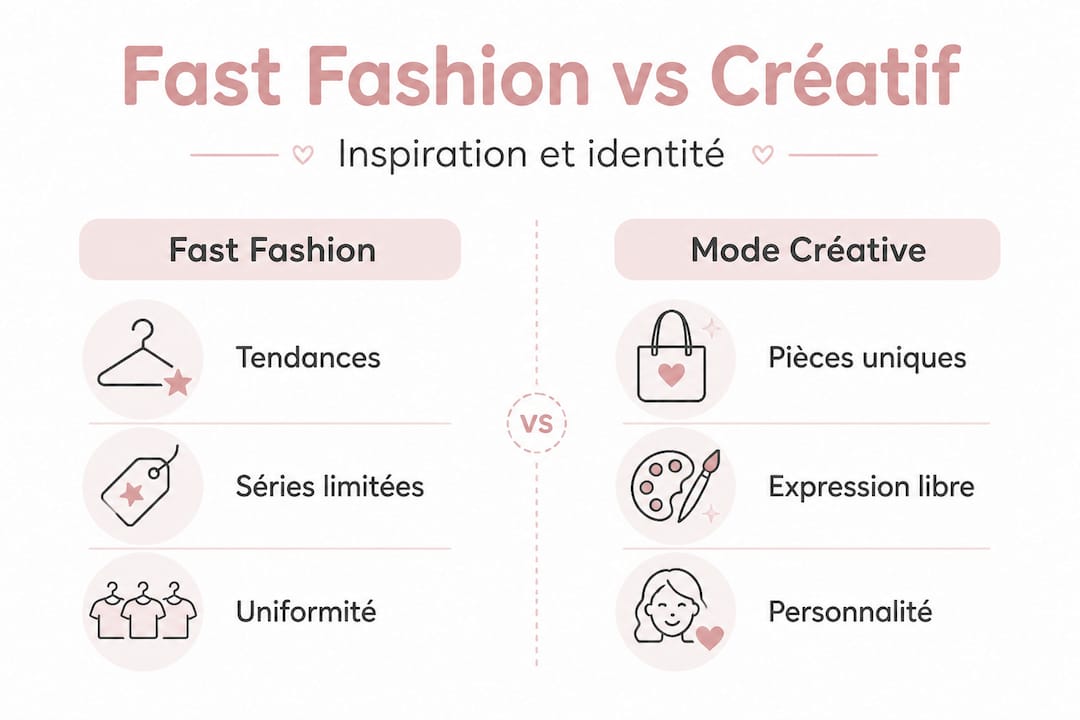
The clothing choices of young creatives often oscillate between these two poles. Finding a balance requires better self-awareness and more intentional selection.
Pro tip: Before buying a new item, ask yourself one question: “Would I wear this even if no one else was wearing it?” If the answer is yes, it’s a purchase that truly reflects your identity. If you’re hesitant, it might be the influence of current trends.
Explore a accessible and creative fashion allows you to break with mass-market logic without sacrificing your budget. Similarly, taking an interest in the slow fashion and creative values opens a path towards a wardrobe more consistent with who you truly are.
An original piece isn't worn like any other garment. It's chosen, it's a statement. It becomes a visible part of your identity. For young creatives, this is precisely where fashion takes on its full meaning.
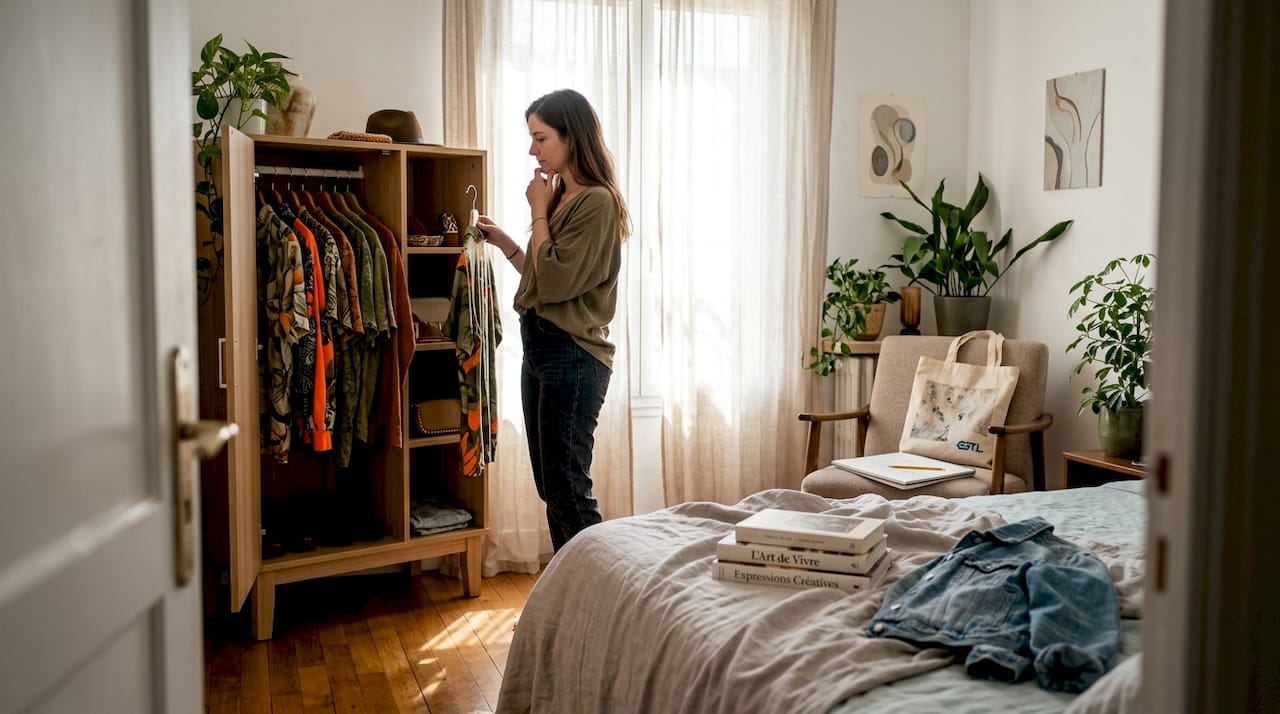
Fashion acts as “armor” for confidence and individuality.Original pieces bypass fast fashion to achieve an authenticity that mass-produced collections cannot offer. Wearing something rare or intentionally created changes one's relationship with oneself.
Here's how to choose and use a unique piece as a means of conveying identity:
Some types of original parts that work particularly well:
“What you wear is a window into your inner world. Unique pieces are those that show how rich that world is.”
Explore creative clothing styles allows one to find references and stylistic directions suited to a strong personality. The connection between art, fashion and streetwear is particularly fertile ground for urban creatives who seek to bring their artistic sensibilities into everyday life.
THE creative wearable collections and the original accessories They complement a coherent approach to fashion as self-expression. Each intentionally chosen piece becomes a visible fragment of your identity.
There's something paradoxical about the quest for sartorial originality. We want to be unique, yet we often look around us to see how to achieve it. We seek to stand out, but by using the codes of a reference group. This paradox isn't a weakness. It's a deeply ingrained human reality.
Fashion as freedom of expression is an appealing idea. But it sometimes masks another truth: fashion can also be a constraint disguised as choice. "Alternative" or "creative" trends themselves end up becoming uniforms. Counterculture becomes standardized. The individual becomes collective.
What truly distinguishes authentic expression from mere imitation is the intention behind the choice. Wearing a piece because it moves you, because it embodies something you feel, is what gives your style real depth. It's not originality for originality's sake. It's coherence between your inner and outer selves.
Artistic creation offers a tangible outlet here. When a garment is born from a genuine artistic process, it carries an energy that mass production cannot replicate. It doesn't seek to please everyone. It seeks to resonate with those who understand it. That is precisely where its strength lies in its identity.
For those who want to cultivate their personal style in a profound way, the question isn't "what's trendy?" but "what reflects who I am?" These two questions lead to very different wardrobes and very different identities.
For young creatives who want to go beyond trends and build a genuine personal style, estlshop.fr offers a selection designed with this in mind. Gary Kago's collections, such as "Joy & Freedom", combine graphic art and wearable fashion with a clear intention: that each piece becomes a visual affirmation of who you are.

The t-shirts, sweatshirts, and accessories available in the shop are more than just clothes. They are the product of genuine artistry, with colors, shapes, and prints that speak to those seeking uncompromising originality. The shop also regularly offers discounts, making this wearable art accessible without sacrificing its unique character. Exploring these creations means discovering pieces that have something to say.
Those who wish to assert their individuality choose original, often creative or artistic pieces, selected to stand out and express their identity. These original pieces bypass fast fashion to achieve an authenticity that mass-market collections cannot offer.
Yes, dressing according to one's desires clearly improves self-esteem. A study of students shows that 80% of them say that dressing well boosts their confidence on a daily basis.
Simply prioritize unique pieces, slow fashion, or wearable works of art. Original pieces, for their authenticity, allow you to express your personal style without succumbing to mass conformity.
Clothing signals social identity and reinforces self-esteem through group affiliation. According to Tajfel and Turner's theory, clothing choices function as visible signals of social belonging and distinction.


